Romeo Is a Dead Man PC Review
It has been five years since Grasshopper Manufacture last gave us a new game, which was No More Heroes III, the latest entry in their beloved cult action series. Even so, it feels far longer since we have delved into the creative mind of this studio when you consider that it has been nearly a decade since they introduced an entirely new IP in the form of the free-to-play Let It Die.
There is something unique about Grasshopper Manufacture games, from their outrageous design to their unhinged plots and their punk identity. There is a quality to them that feels deliberately absurd. It is that style, more than anything else, that keeps me coming back to their games, regardless of how rough around the edges they might be. Romeo is a Dead Man continues this trend and is entertaining for that reason alone.

Players take control of Romeo Stargazer, a deputy sheriff in the quiet town of Deadford, Caliban County. The game kicks off when Romeo and his superior discover a mysterious body on the road. After stepping out to investigate, Romeo is brutally attacked by a White Monster, leaving him on the brink of death. Just as he is about to die, a figure on a bike appears out of the flash, this is Romeo’s granddad, Benjamin Stargazer. His grandad is a brilliant scientist and saves his grandson by stabbing a device in his eye that happens to be an experimental technology called the Dead Gear, a piece of equipment that functions as a life-support helmet.
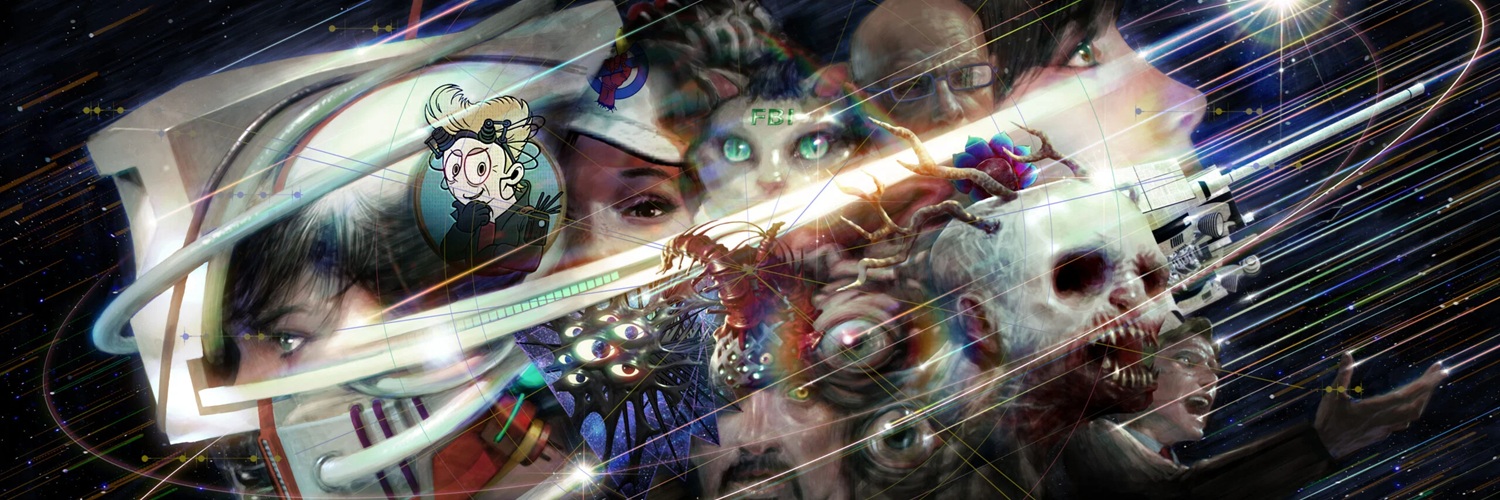
Now known by the alias “Dead Man,” Romeo is recruited by the FBI’s Space-Time Division (yep, they are in space now) and is tasked with tracking down dangerous criminals who have escaped into different timelines, while finding where his mysterious girlfriend, Juliet, has gone. This girl appears in various timelines as a different version of the one he knows, and so he kills those imposters until he can find the right one that he fell in love with.

It is another deliberately nonsensical plot that can feel scattered at times, with the time-hopping multiverse premise giving Suda51 the freedom to lean into his absurdity. The result is a mix of stylish presentation and chaotic storytelling, where flashy animated sequences and cool 3D visuals are contrasted by stretches of dialogue that take place aboard the spaceship, The Last Night.
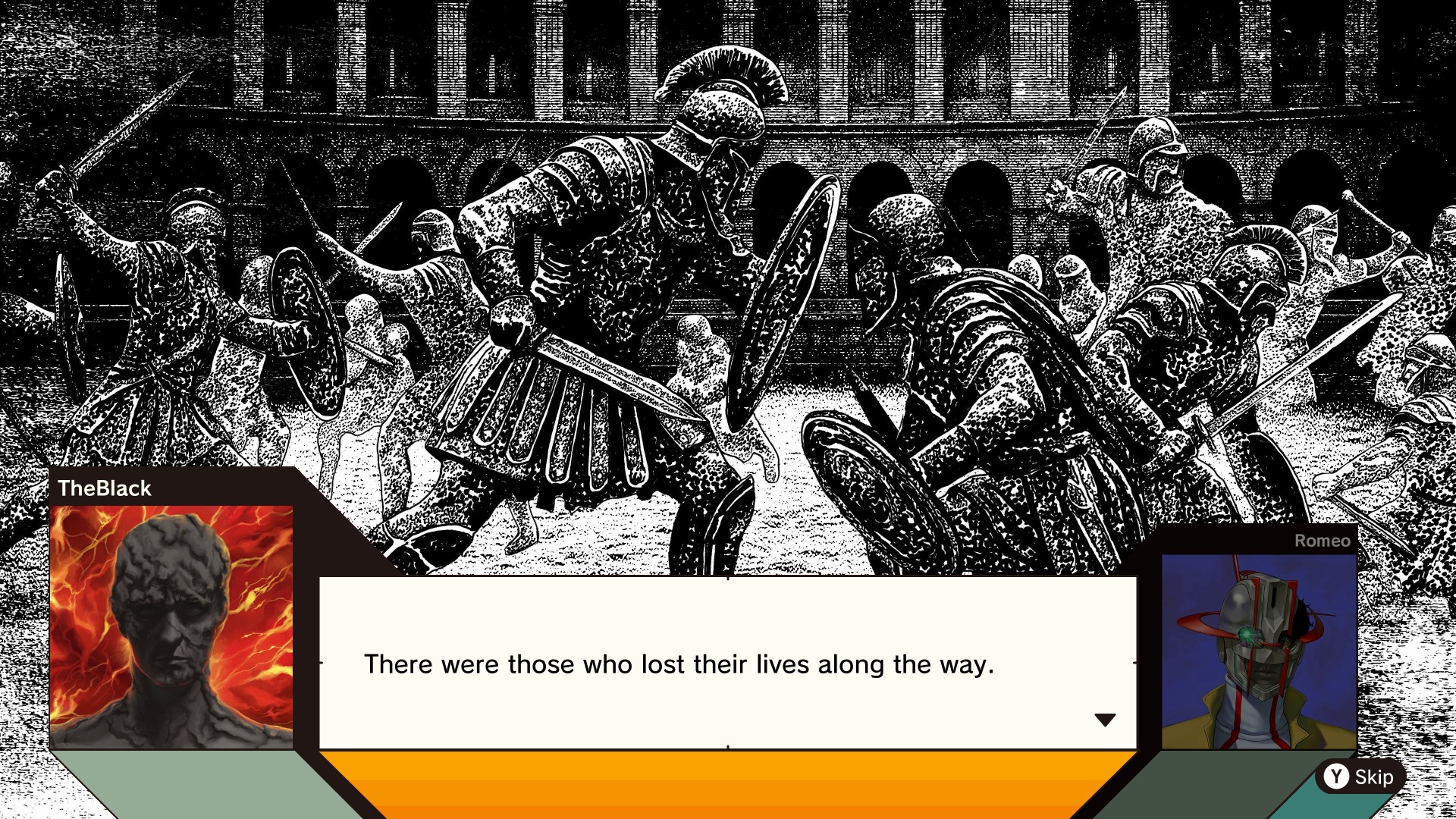
Between missions much of this interaction is presented in an isometric 2D perspective, using visual novel-style portraits and text to deliver exposition and character moments. The crew itself is as eccentric as you would expect from Grasshopper Manufacture, featuring a mix of humans, unusual humanoid figures, and an entity embedded in a painting that add to overall wackiness. While this approach helps build the studio’s absurd creativity – the random animated song near towards the end of the game that leads into a old school side scrolling story segment is one element that showcases this wonderfully – some of them can also slow the pacing, especially when conversations drift away from the central narrative and begin to feel drawn out.

At its core, Romeo is a Dead Man is a third-person action game where you control Romeo, swapping between melee and ranged attacks to take down the monsters that infest these timelines. Fans of Grasshopper Manufacture’s previous work will feel right at home, as this style of over-the-top action isn’t new for the studio. The game is structured into chapters, each delivering part of the story built on a themed level within a set time period, and most often featuring a boss at the end. These levels are filled with enemies that you dispatch using four melee weapons and four ranged weapons. You start with only the melee Spazer (a lightsabre-style katana with chainsaw blades) and the ranged energy pistol Discovery. The rest are quickly unlocked using the game’s currency, Emerald Flowsion, at the DeadBall Unlocker, which is accessible at save points or aboard The Last Night.
The other melee weapons lean into classic tropes: the Star Destroyer (a heavy, slow big-ass sword), Juggernaut (steel fists that demand you get right up close and personal), and Arcadia (a versatile spear that can split into two smaller weapons). On the guns side, you’ve got the Diaspora (shotgun), Nebuchadnezzar (machine gun), and Yggdrasil (sniper cannon). For the most part, I found myself switching between the heavy sword and the standard blade depending on my mood. However, the lighter sword feels the most optimal overall as its faster animations make it easier to dodge or jump away from danger. For ranged combat, I alternated between the shotgun and machine gun. The shotgun delivers strong close-range damage, while the machine gun excels at constant damage and remains effective even at longer distances without noticeable drop-off in its damage.

Combat leans toward the simpler side, with set combo chains built around light and heavy attacks, alongside dodge and jump options for evasion. Notably, there are no block or parry mechanics, which is something I have grown accustomed to in similar games. I had to unlearn the instinct to press LB expecting a block here, as in this case, LB activates shortcut inputs for one of the game’s more unusual systems: the Bastards.
Yes, the name is an amusing one, especially when they recharge after a cooldown use and the game says, “Release the bastards”. Bastards are zombie-like minions grown from seeds dropped by enemies, which can then be cultivated in a specialised garden. Each Bastard has a unique function, and they can be fused together to improve their stats and overall effectiveness. They come with a wide variety of abilities: some act as stationary auto-turrets, others create healing zones, fire lasers, knock back enemies, apply poison, generate protective barriers, or even form a linear energy beam between themselves and Romeo that damages anything caught inbetween. They are some good use cases for these, some more so than others within the 20 or so available to discover and grow in the game, with up to four being able to be equipped at a time to use.
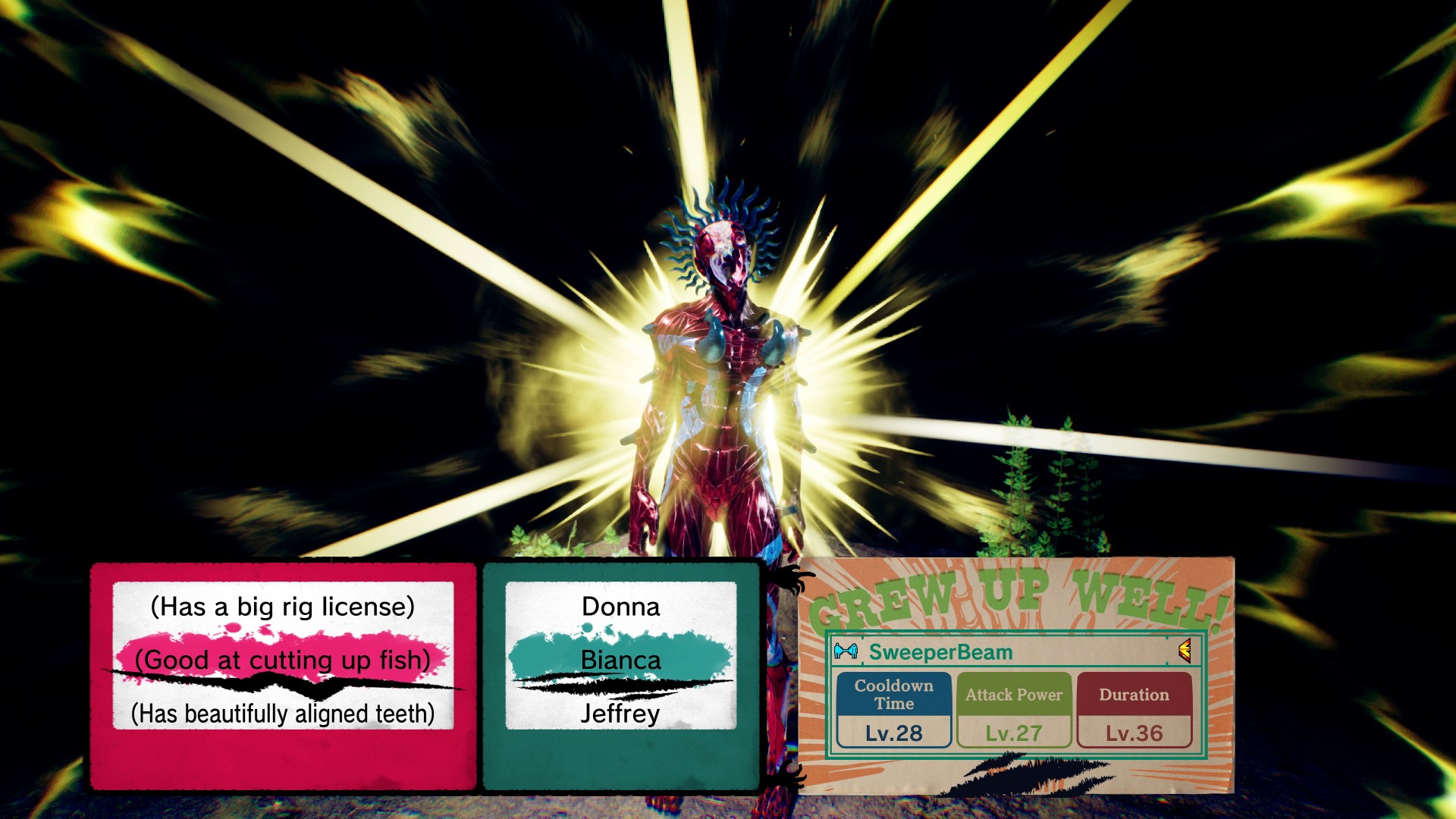
Alongside the core combat sits the Bloody Summer system, a meter that fills as you land hits on enemies, with each weapon having its own efficiency for drawing blood. Once full, holding RB triggers a powerful special attack that works across both melee and ranged weapons, dealing significant damage while also recovering a small amount of health regeneration.
Combat in Romeo is a Dead Man is more hack and slash rather than the technically demanding character action genre, and that is fine, and it does a nice job of showering enemies into luminous sparks for good visual effect so that the game at least looks stylish. Grasshopper Manufacture has never been a studio chasing the mechanical depth of a Devil May Cry or Bayonetta. That’s not necessarily a drawback, and fans of Grasshopper Manufacture will likely know what to expect going in.
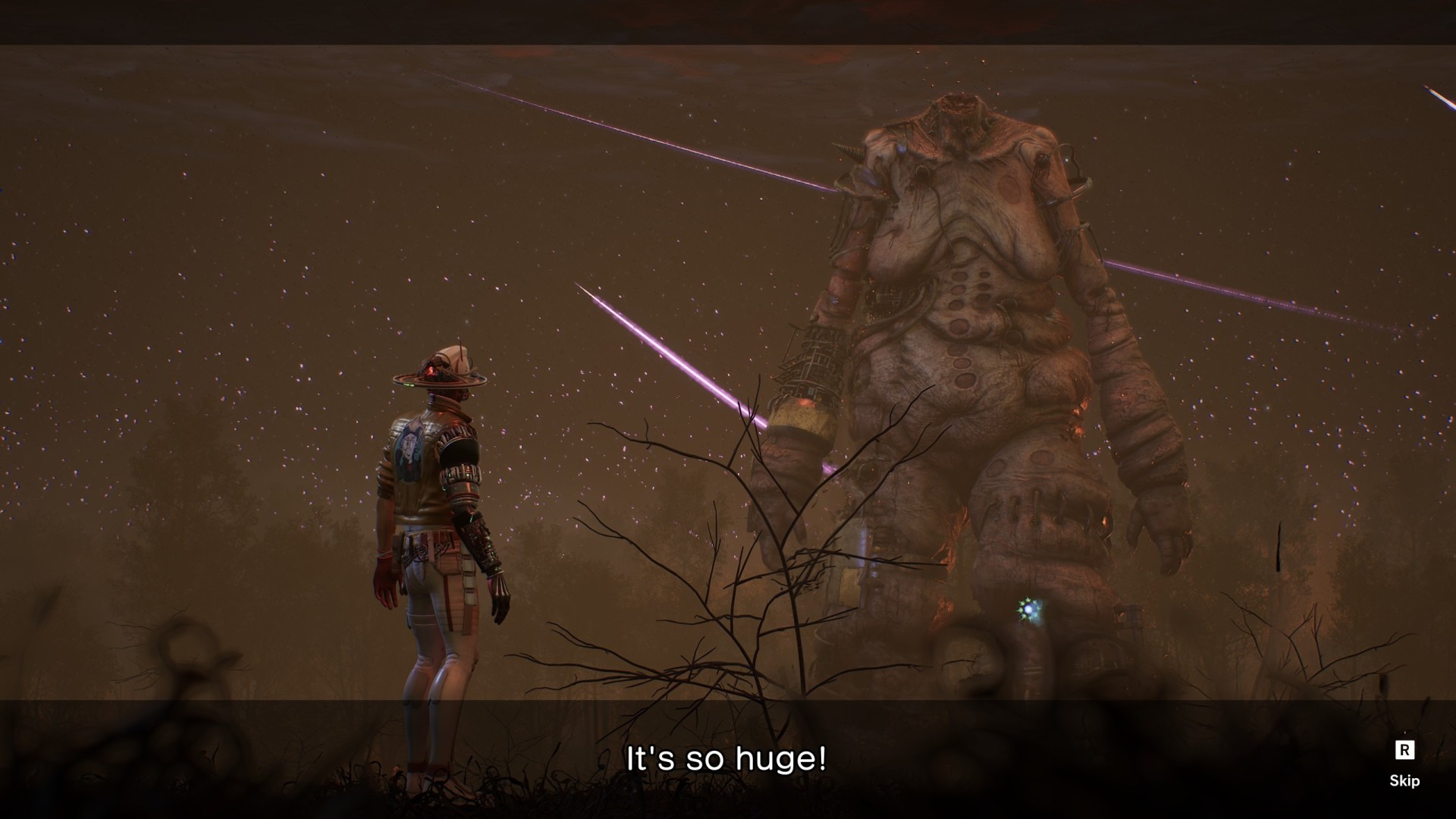
Foes come in various shapes and sizes, collectively dubbed Rotters. These zombie-like enemies will either rush you down with melee attacks or engage from a distance with ranged weapons. Early on, they’re simple to deal with, but as the game progresses, enemies require more effort to take down. Many feature weak points that need to be targeted either through precise shots or well-placed melee strikes to dispatch them efficiently. Otherwise, they can feel overly spongey, even after upgrading the weapons in the shop using coloured Sentrey or upgrading Romeo himself with the little arcade mini game that spends Emerald Flowsion to travel a maze in a 2D game to find upgrades to powerup Romeo.
The main issue, however, is a lack of enemy variety. By the final chapter, the repetition starts to wear on the combat. You encounter familiar types repeatedly: large enemies with weak spots on their backs and flying green creatures that can only be damaged with melee attacks until their protective shield breaks, exposing the zombie inside to both melee and ranged damage. These ideas work in moderation, but they become overused in that final level. Unfortunately, that stage is also one of the weakest in the game. Built around the “subspace” aesthetic of boxy rooms and colourful grids, a space in the game featured as ways to jump around locations in a chapter to bypass blocked passageways. This final level throws large numbers of enemies at you in tight spaces. This often leads to frustration, as it’s easy to be knocked off platforms to your death, especially when the lock-on mechanics cause Romeo to shift position awkwardly. Rather than feeling challenging, these moments end up turning the combat from enjoyable to frustrating.

There are some interesting levels throughout the game’s 13 hour adventure, with the asylum standing out as a highlight. It mixes the standard action combat with light puzzle-solving and escape room-style mechanics, giving it more variety than other stages. The level leans into a horror tone, as Romeo must avoid these beasts patrolling the corridors of the asylum while jumping between the real world and subspace to get through the time loop and find the right room that leads to the boss.
Powered by Unreal Engine 5, Romeo is a Dead Man shifts between multiple styles, from 3D action to sequences in 2D and various artwork done in multiple of ways. On higher settings, it makes use of modern Unreal Engine 5 features such as Nanite and Lumen. That said, at maximum settings, the game doesn’t always look as demanding as its performance would suggest, but that is often the case with a lot of Unreal Engine 5 games. Running on a Ryzen 7 7800X3D and an RTX 5090, I was only just able to maintain 60fps, with drops into the low 40s during more intense combat scenarios. To improve performance, I enabled Nvidia DLSS on Quality mode, which helped the frame rate above 60fps. The settings menu is somewhat confusing for using DLSS. The feature is controlled through a “Graphics Quality” option that adjusts it. “Low” corresponds to Performance mode, while “Ultra” represents native resolution. It’s an odd choice, especially when Nvidia’s standard DLSS naming conventions are understand by people.
The best praise you can give Romeo is a Dead Man is this is probably exactly what game you would expect from Grasshopper Manufacture and Suda51. It has that Suda51 personality embedded within it, even if it is a bit rough. Its stylish presentation, absurd storytelling, and amusing ideas like the Bastards system, along with entertaining combat help make it a fun time, but it eventually becomes repetitive as enemy variety thins out in the later stages with that frustrating level design. Still, for fans of Suda51’s work, there is stuff here to appreciate. It is a little messy, somewhat inconsistent, and a bit rough, but unmistakably a Grasshopper Manufacture game, and that alone will be enough for some people. What I am trying to say is that Romeo is a Dead Man is good, but in a quaint, unconventional manner.