Gunfire Reborn PC Review
Gunfire Reborn is not a new release, having first launched on PC in November 2021, but it’s a game that should have some attention with the ever-growing crowd of roguelike fans, which is probably why the developers reached out to the site to see if we would like to fill that void with a review for Gunfire Reborn.
With the recent release of new downloadable content titled Echoes from Primal Grove (which I purchased to try out the new content), this seemed like the perfect time to give it a review on our site. Over the past few weeks, I’ve been playing several roguelite games such as Out of Time, Megabonk, Balatro, and Absolum, so this felt like a great opportunity to see what this blend of FPS action, roguelite, and RPG gameplay has to offer. This was my first time playing Gunfire Reborn, and I was eager to find out how well it holds up in a genre that has grown crowded with so many unique and inventive variations over the last few years.

The story for Gunfire Reborn is close to non-existent. There is no fancy long introductive cutscene or pages of text. What there is to setup the game’s premise is a brief 15 second intro sequence (still-art/comic‐style visuals) setting up the premise of the Crown Prince investigating a demonic presence, suffering a fall, awakening and being brought back by Uncle Bao. It’s said that the hero was investigating the gathering of monsters in a location before meeting his end. It’s here where we find out that the blue ghastly entity is a demonic aura that has gone rampant, and so the player is once again set off to kill all these enemies again and again until successful, no matter how many deaths occur. The narrative disappears after the brief opening sequence, and you rarely hear anything else about it throughout the game bar short couple of sentences after beating a difficulty for the first time. The story clearly takes a back seat to the gameplay: it gives you a goal, then gets out of the way. There’s nothing substantial to evaluate beyond that, the game doesn’t bother building on it.
The fact that Chinese game studio Duoyi Games has offered only a minimal story makes it clear that the focus in Gunfire Reborn is firmly on gameplay. In simple terms, this is a first-person shooter with roguelite mechanics built into it. You pick a hero with a specific set of abilities, enter the game’s small levels, defeat enemies, gather new weapons and buffs, and try to push as far as you can before you eventually die. Then you repeat the process with improved stats thanks to the roguelite progression. It is a formula that has become extremely popular in recent years because of how addictive that loop of failure, improvement, and eventual success can be, and Gunfire Reborn leans into that appeal just like any other good roguelike. With guns as loot, there is a faint echo of Borderlands, though without the overwhelming number of weapons that Borderlands famously highlights in its marketing, still there are some entertaining ones featured in here.

The base game of Gunfire Reborn comes with six available characters, although in the beginning only Crown Prince is available, the remaining five heroes are unlocked through either hitting talent account level goals, such as the dog, Ao Bai, who unlocks when the talent level is 25. The other two are unlocked through spending Soul Essence, which is the game’s currency gained during playing that is used to unlock elements in the talent tree. With four pieces of downloadable content available, Visitors of Spirit Realm, Artisan and Magician, Realm of Frost and Inkwash, and the shiny new Echoes from Primal Grove, means that the cast has increased from six to 14, more than double what the original game had.
Gunfire Reborn features a cast of distinctive anthropomorphic animal heroes, each with their own visual identity. Ao Bai is inspired by a Rottweiler, complete with a bandana and a tough attitude that feels like he could have stepped out of the mid-2000s Grand Theft Auto: San Andreas setting. Qian Sui is a turtle themed brawler who looks like a deep-sea fighter, thanks to his bulky body and diving goggles, along with minimal underwater style clothing and leaf accessories. Lei Luo is a white tiger infused with lightning, which gives him a dramatic and almost Raiden from Mortal Kombat kind of energy, only without the iconic conical hat. Not every design tries to look tough or intimidating. Some of the heroes go for a cuter or more graceful style, especially a few of the feminine characters. The variety across the roster keeps things visually interesting, and every hero fits the game’s blend of mythical adventure and human animal design.
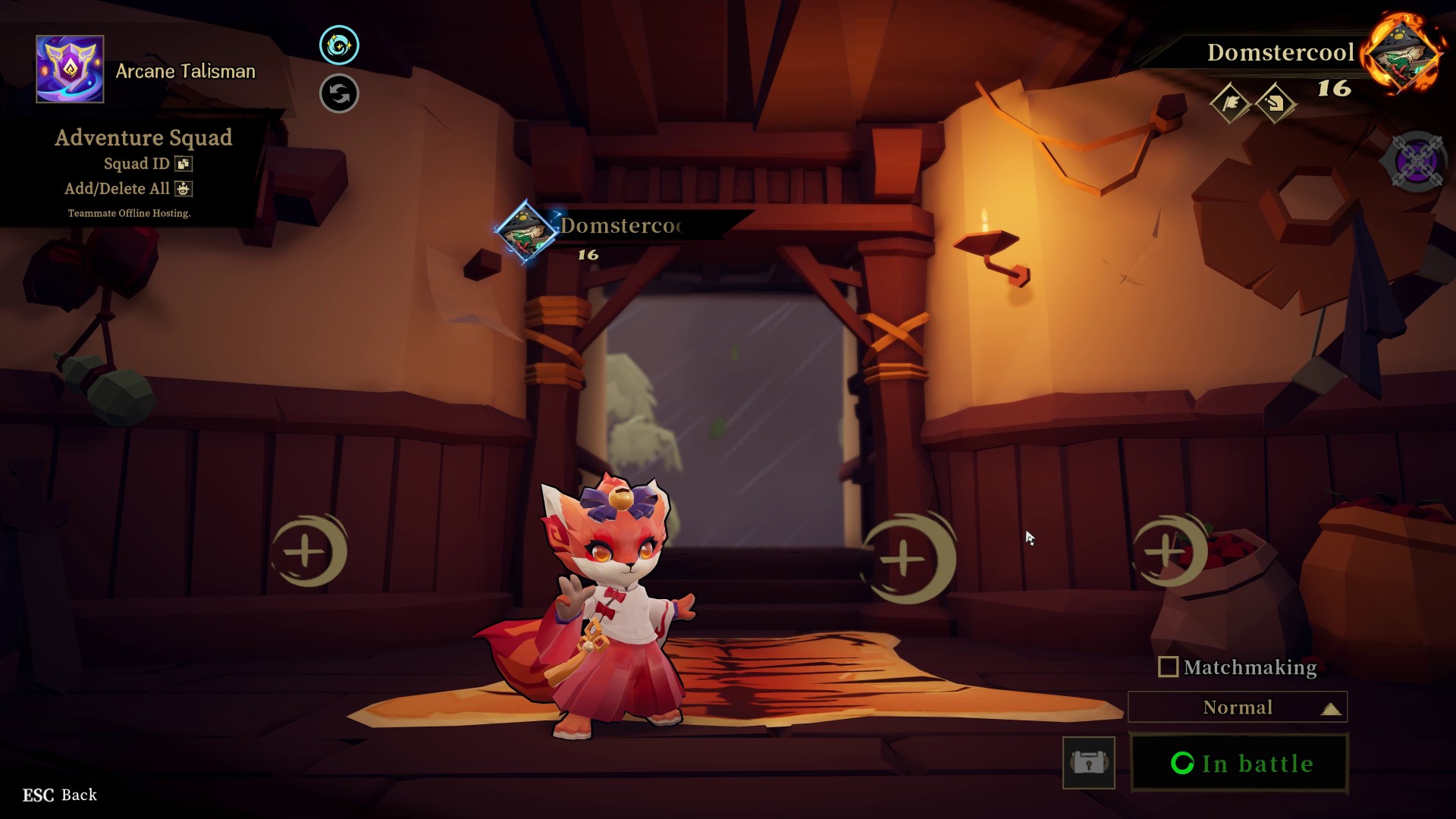
Along with different base stats for health, shield, and speed, each hero also has a primary and secondary ability that defines their playstyle and encourages taking them for a spin. The primary skill is usually the more powerful option, often suited to big damage or strong utility. The secondary skill is weaker but can be used more frequently and regenerates over time or through dropped supplies from defeated enemies.
One of my favourites to use is Li the fox from the Visitors of the Spirit Realm DLC. Li focuses on fire-based damage. Her primary ability, Spiritual Flame, channels a powerful fire blast that hits hardest when fully charged and can apply a burning status effect for damage over time. Her secondary ability, Blazing Meteor, drops a fireball from above that deals fire damage and can also ignite enemies. She plays like a high risk, high reward glass cannon hero who feels great once you get into the rhythm of melting enemies before they get too close, just don’t get hit too much!

Across the full roster of heroes, you will find primary abilities such as dual wielding, summoning swords, creating barriers that block front facing damage, controlling a mech companion, and even the latest hero who switches between a brute form and a mystic energy form. There is a decent amount of variety in the move sets, though some secondary skills feel like slight variations of each other rather than truly unique, such as Qing Yan’s Cleave and Qian Sui’s Striking Punch, both melee but tuned for different ranges and impacts.
No matter which hero you pick, you always kick off with the Foundry, a basic pistol with a nine-round magazine and unlimited ammo that stays glued to your inventory for the entire run. The other two weapon slots are fair game for anything you loot along the way, letting you freely hot swap between guns as your arsenal evolves. Weapons consume one of three ammo types: Light for speedy pistols and SMGs, Heavy for harder-hitting rifles and shotguns, and Special for launchers and more experimental weaponry. Ammo reserves are capped, but scarcity is practically non-existent. Defeated enemies drop stacks of ammo littered everywhere, so you will almost never feel pressured by ammunition management until the game moves to the harder difficulties, even then the maximum clip can be increased through upgrades. As of the latest downloadable content, Echoes from the Primal Grove, Gunfire Reborn features 71 weapons in total. The base game includes fewer, as each DLC typically adds around four new weapons, with sixteen in total have been added so far.

Weapons are divided into categories such as Rifles, Snipers, and Injectors. For example, the Big Hippo, a sort of mini gun falls under the Rifle category alongside the Dragonchaser, a green rifle that looks more standard in its design. The Crimson Firescale, which resembles a fish, can fire explosive fireballs in its alternate mode. Not every weapon has an alternate firing mode, though, some just allow you to aim down sights, like the Sniper-class weapons String and Double Caliber.
What makes Gunfire Reborn’s arsenal stand out is the creativity of its designs. Inside the Injectors class lies one of my favourites, the Jet Octopus, a small squid-like weapon that damages enemies in a cone and absorbs their energy. Once charged, it can unleash a devastating stream of water that vaporises the enemy health bar. The Starfly, shaped like a jar with a strange creature on top, auto-locks onto targets and fires barrages of energy orbs. When its energy bar fills, it unleashes an even larger storm of blue projectiles, a dazzling display of blue destruction. Other inventive weapons include the Radioactive Gauntlet, reminiscent of Iron Man’s glove, live lizards that spit fireballs, and the harp-like Crane Chant, which releases energy blossoms with each strum.
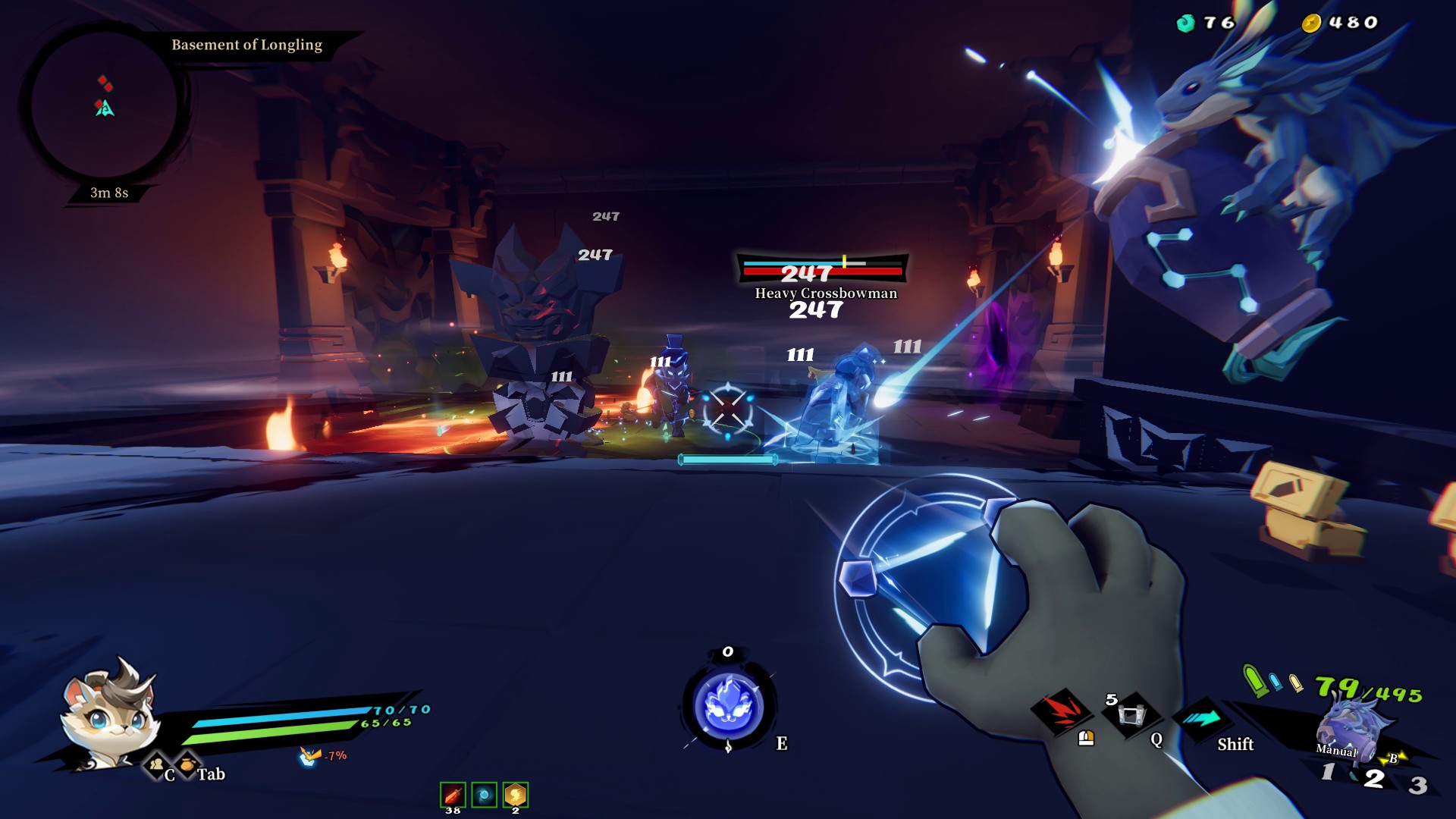
Across most weapons, the gunplay feels solid and satisfying enough. The conventional firearms deliver a familiar arcade impact, while the stranger weapons bring a joyful play to combat. Sound design is good enough, as each hit produces an arcade-like punch, and headshots land with a pleasing “Donk” that alerts when a weak point is hit. Ultimately, Gunfire Reborn offers not just traditional weapons, but also destructive toys that spice up the typical arcade shooter gameplay. That said, if you are expecting gun combat as well crafted as something like Battlefield or similar shooters, then you will be disappointed as this is clearly not going for that feel.
Weapons in Gunfire Reborn come with additional stats called Inscriptions. These are modifiers that are randomly applied when you find new weapons. As you progress further into a run, you’ll encounter higher-level weapons with more and stronger inscriptions. These modifiers are key to building powerful loadouts that can dramatically affect your survivability and playstyle.

Inscriptions come in different rarity tiers, with orange ones offering the most powerful effects. These can range from increasing damage based on the number of bullets in a magazine, boosting damage against specific elemental types, guaranteeing weak-point hits, generating fireballs on critical hits, and improving rate of fire and reload speed. The variety is huge, and stacking the right combination can make your character feel relentless. There’s also a unique purple inscription type that links your two non-default weapons. These provide bonuses that affect both at once, such as combining their total magazine capacities, or sharing elemental traits so that both weapons can inflict each other’s elemental effects. It’s a neat system that helps keep runs feel a bit different when it comes to gear collection and adds that surprise element to picking up weapons. As with anything luck base, sometimes you can just get inscriptions that feel weak, but thankfully weapons drop frequently from foes.
The last components that contribute to temporary stat boosts during a run are Scrolls and Goblets. The latter grants Ascensions, which are passive upgrades unique to each hero. You can think of them as specific skills that remain dormant until unlocked with a Goblet. Each time you find one, you’re presented with a choice of three Ascensions. Some are single-level upgrades, while others can be levelled up multiple times to further strengthen their effects. These Ascensions can dramatically change how a character plays. For example, Momo, the ink-based hero, can develop such powerful secondary attacks and area-of-effect abilities that I felt like a cutesy killing machine, there’s just something very incongruous about that.

Scrolls work similarly but are more general in nature, offering passive buffs. These include bonuses like increased damage, faster movement speed, faster reloads, health regeneration, or extra damage when at full health. Some Scrolls even trigger special effects, such as gaining a buff after taking damage. There are also Cursed Scrolls, which apply debuffs to the player, but some builds can turn these into advantages, for instance, gaining 20% more damage for every Cursed Scroll held. Together, Scrolls, Goblets, and weapon upgrades form the backbone of the game’s progression loop. As difficulty rises from Normal to Elite, Nightmare, and eventually Reincarnation, which has 10 difficulty numbers within (like Diablo III’s Torment tiers), making good use of these systems becomes vital to win.
And, as with any good roguelite, death isn’t the end. Each run rewards you with Soul Essence, which can be spent to unlock permanent upgrades that benefit all heroes, along with five unique skills for each hero that must be unlocked individually. It’s a satisfying progression system that ensures every failure feeds into a stronger next run.

Character progression and gunplay are the strongest elements of Gunfire Reborn, which feels amusingly fitting for a game with “Gunfire” in its name. However, moving away from that and into the game’s level design is where things become less compelling. The game features four biomes that make up its four acts: the Tombs, Desert, River Cliffs, and Snowy Mountains. Each act consists of several short stages that lead to a boss fight at the end. While the different biomes give each act a distinct visual theme, the level layouts themselves often feel basic and repetitive. Most areas share similar structures and room patterns, with only minor variations between runs. You’ll occasionally encounter shopkeepers who sell new buffs, weapons, or items, as well as hidden portals on walls that lead to small challenge rooms. These optional areas offer a risk–reward mechanic, giving players valuable buffs in exchange for taking on tougher enemies.
The main issue is that while the weapons are memorable, the levels are not. The environments lack standout features, and even though the stages are partially randomised, the procedural generation doesn’t alter the core design enough to keep their layouts feeling fresh. This repetition can make the game feel predictable after multiple playthroughs. Adding more biome variety, rejigging their order or adding greater randomisation would help alleviate the issue by bringing more random elements to the gameplay. Alternative bosses can appear once you’ve defeated the originals a few times. After unlocking them, these bosses can randomly appear at the end of their respective acts, adding a welcome touch of unpredictability, which is what the levels are sorely missing!
I can’t help but feel that the developers were aware of the game’s shortfall in level design. Once the higher difficulties are reached, several new features unlock that seem designed to keep the gameplay fresh and engaging. One of these is Bizarre Dream, a feature that becomes available after reaching the fourth difficulty. It introduces new options that let players customise their runs in interesting ways. Interdependent Fortunes is one such option. At the start of a run, the player can select four scrolls and gain their buffs, but the trade-off is that all enemies will also spawn with those bonuses. Ascension Fusion allows ascensions from other heroes to appear during a run, enabling creative combinations of skills that were previously hero specific.
Seasons are another major system. Season 5, which was ending when I started playing, introduced Talismans, which were items that grant passive effects and have gem slots for additional buffs. Season 6, which began during my playtime, focuses on Luck, where players discover dice that contain buffs whose strength depends on the number rolled. The higher the number, the rarer and more powerful the effect, ranging from common to legendary. These features are all clever ways to change up the gameplay and extend the game’s life. I appreciate how they add variety and new layers to each run, and that Seasons, even though ended, can still be selected so their gameplay twists are accessible after they end, but I can’t help wishing the developers would focus more on improving the level design.
Developed with Unity, Gunfire Reborn keeps its graphical demands low through its low-poly art style and bright, colourful cartoon visuals. This art direction gives elements like its characters and landscapes a distinct, angular, polygonal look. It’s a charming aesthetic, though the lower level of detail can contribute to the sense of sameness in the environments. The benefit of this minimalist approach is excellent performance. The game runs smoothly on virtually any PC from the past decade and is a great fit for the Steam Deck, consistently hitting 60 frames per second without issues. With individual runs lasting around 45 to 90 minutes, Gunfire Reborn feels almost tailor-made for portable sessions or quick co-op play with up to four players.
Speaking of co-op, there’s still an active community playing Gunfire Reborn even years after its release. It can be harder to find players on the lower difficulty settings, but those are easy enough to handle solo with the help of bots that can be added to replace players, which do a decent job tanking enemies for you. On higher difficulties, matchmaking becomes more active, and it’s much easier to find a full team in the lobby.
Gunfire Reborn offers a solid mix of roguelite progression, creative weapons, and fun hero abilities, making it a good pick for fans of loot-focused first-person shooters. Its low system requirements and co-op gameplay further enhance its accessibility, and it makes for a great Steam Deck experience. However, the highly repetitive level design is a weakness that can’t be ignored. While expansions and seasonal systems add variety, they feel like compensation for the bland environments rather than a true fix. Overall, it’s a good game that is enjoyable, but not without some flaws that stop it short of greatness.