Out of Time PC Review
While not the originator, it’s fair to say that Vampire Survivors put the “Survivors-like” genre on the map when it exploded in popularity after its 2022 release. The genre, essentially a blend of twin-stick bullet hell shoot ’em ups and roguelike progression, has since spawned countless imitators and evolutions across Steam. Notable titles such as Deep Rock Galactic: Survivor, Jotunnslayer: Hordes of Hel, Megabonk, and Death Must Die have all brought their own spins to the formula, and the momentum shows no signs of slowing down. This is where Manticore Games steps in. Known for their Core platform, which lets users create and share their own games, Manticore has decided to branch out with Out of Time, a standalone Survivors-like that emphasises cooperative roguelike action.
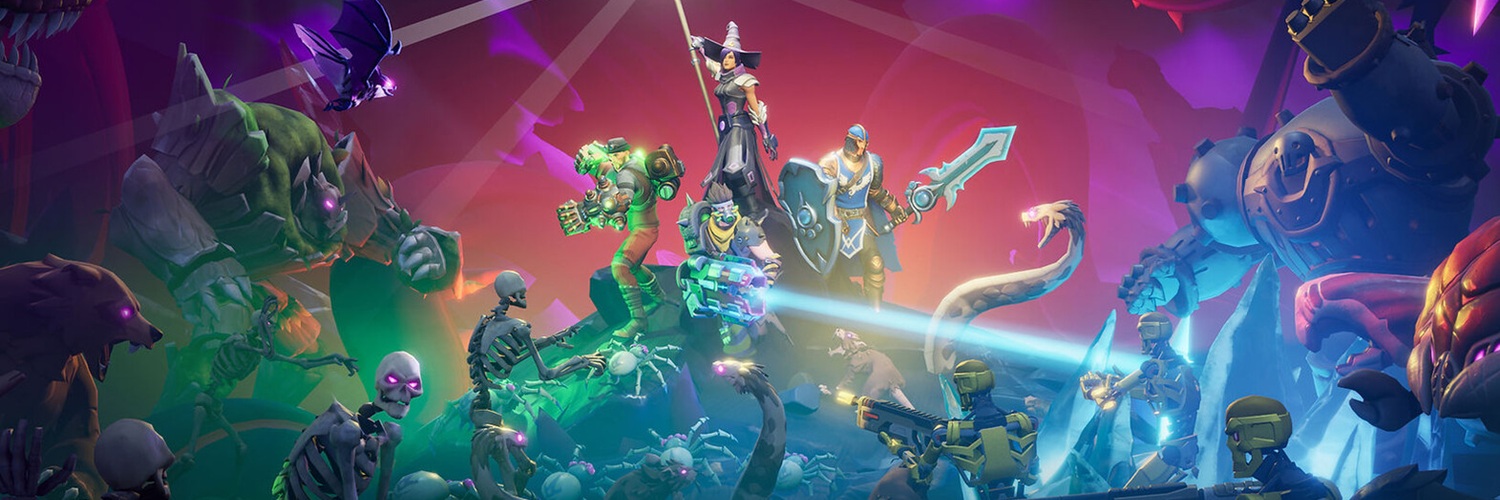
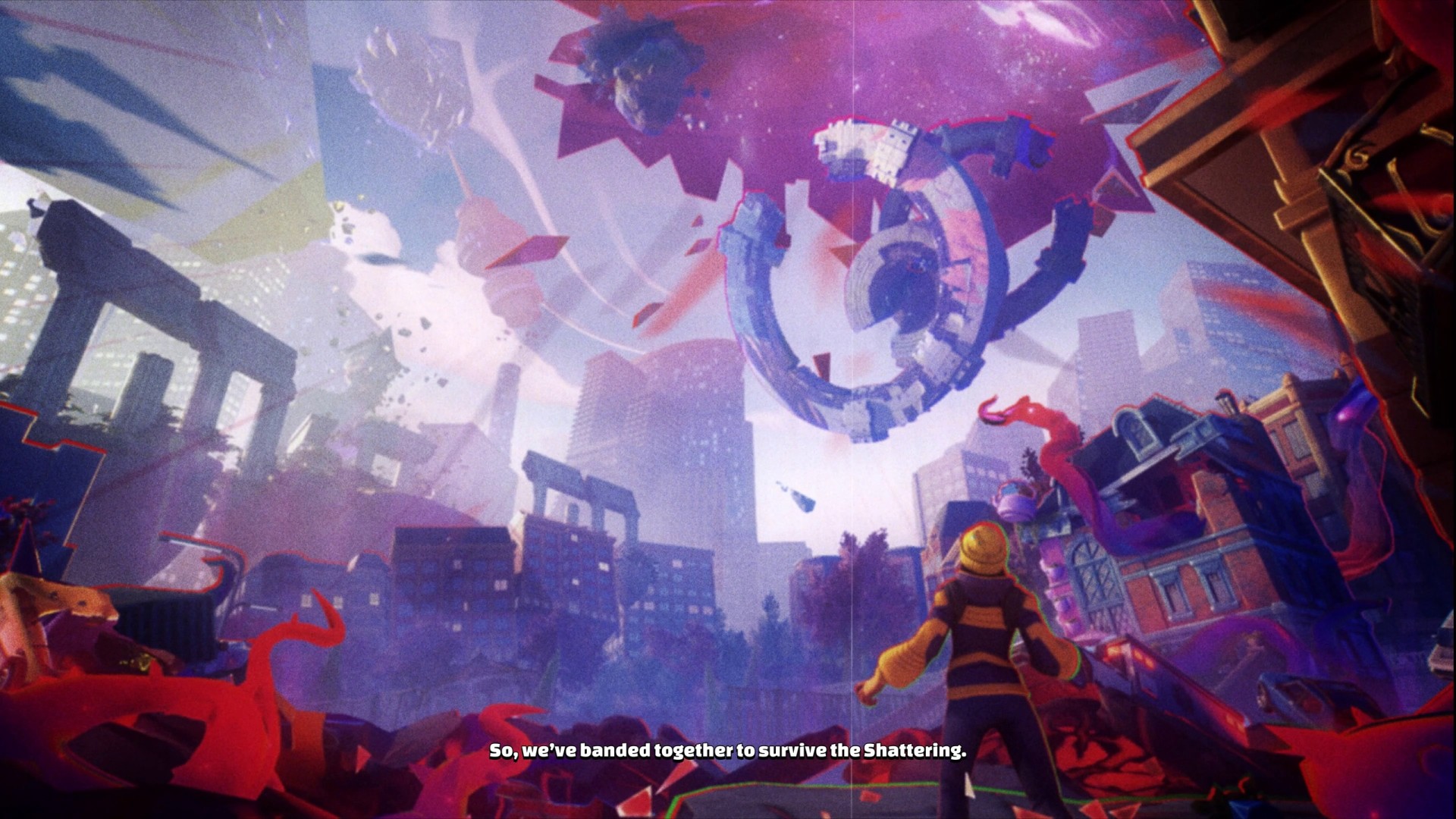
There isn’t much going on with the plot, but the general gist of Out of Time is, well, time. The world has fallen into chaos after an event known as “The Shattering,” which has merged different eras into one fractured reality. Past, present, and future collide, creating a world where portals rip open in the skies and random enemies drop in for players to fight. Humanity’s last stronghold is the city of Infinitopia, home to the resistance fighting against “The Tangle,” a creeping force of purple energy that threatens to consume all existence. Jeanne D’Arc, yes, that Jeanne D’Arc, serves as the game’s tutorial guide, explaining the basics of survival. It’s bizarre and a little silly, but that’s all a game like this really needs to work in the Survivors-like genre.
Upon starting the game, players are greeted with a basic avatar editor featuring 12 prebuilt designs. Each design allows minor tweaks such as skin colour, eye colour, hairstyle, and hair colour, with a small selection of hairstyles and a full RGB colour slider available. It’s extremely basic, and it feels like it’s mainly there to give your starting character some identity. Once that’s done and the tutorial is complete, players spend their non-combat time in Infinitopia, the hub and community area of Out of Time. One of its shops, the Avatar Station, offers more customisation options, letting players transform into aliens, fish-like beings, or even anthropomorphic foxes. Additional options can be unlocked by collecting gear sets including helmets, armour, boots, and weapons, which then become usable cosmetic skins.
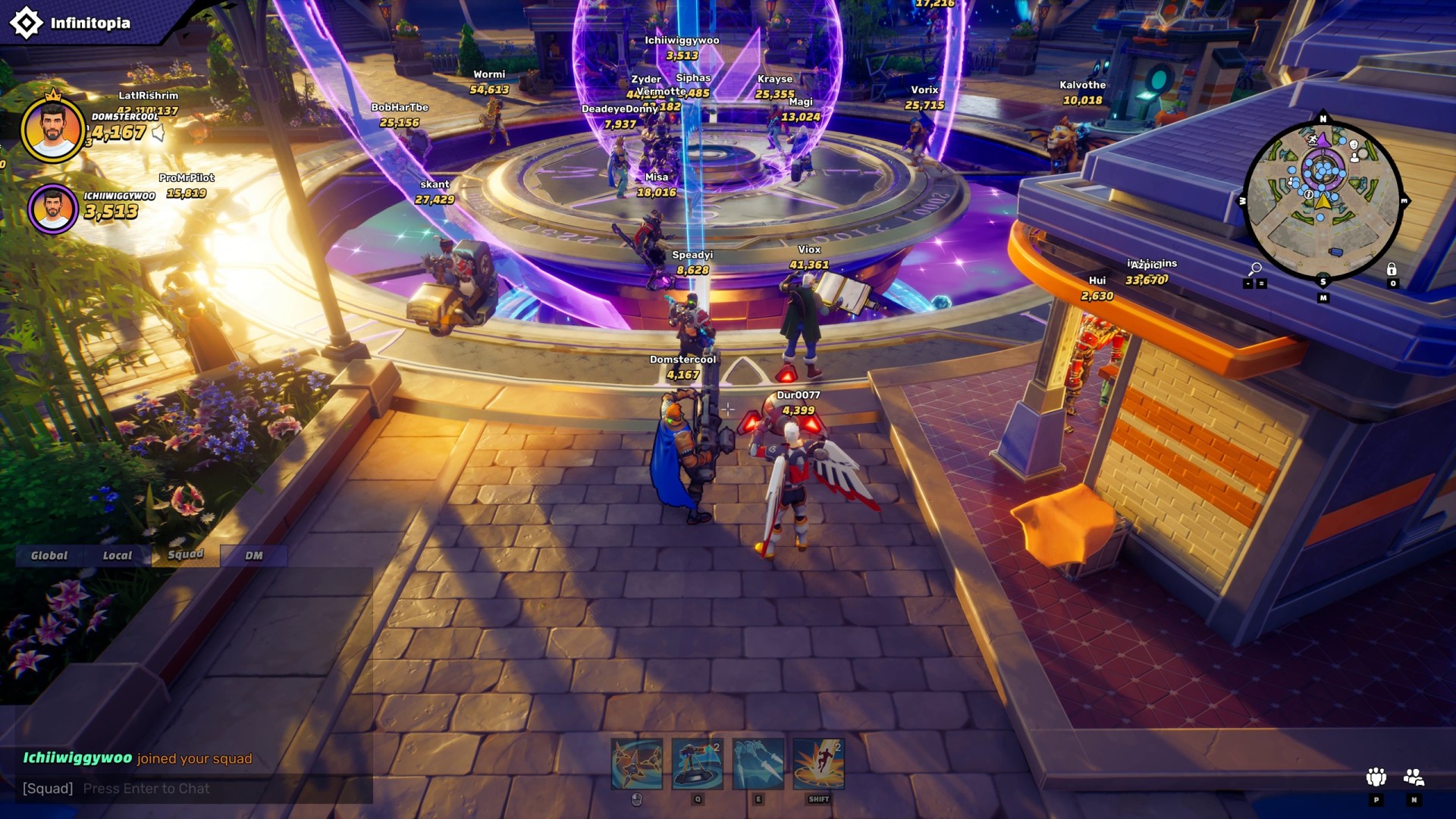
Infinitopia is the active community hub where players can see others and their geared-out characters, complete with a Power Level displayed under each name. I’m not sure how many players can be in a single lobby, but there are clearly multiple instances, since I saw people chatting who weren’t visible in my Infinitopia. This setup adds a nice community element and allows players to form teams of up to four to tackle the game’s levels. There were plenty of players looking for groups to take on the higher difficulties, and a quick invite through the social menu makes it easy to gather a party. In terms of difficulty, in addition to normal and hard modes, the Shattered difficulty introduces tiers ranging from 1 to 10, like how Diablo III handled its ever-increasing Torment levels. It’s a simple way to extend the game’s lifespan but may feel repetitive after several runs. It seems likely that more gear and even higher Shattered tiers could be added in future updates to keep the game active for the top tier players.
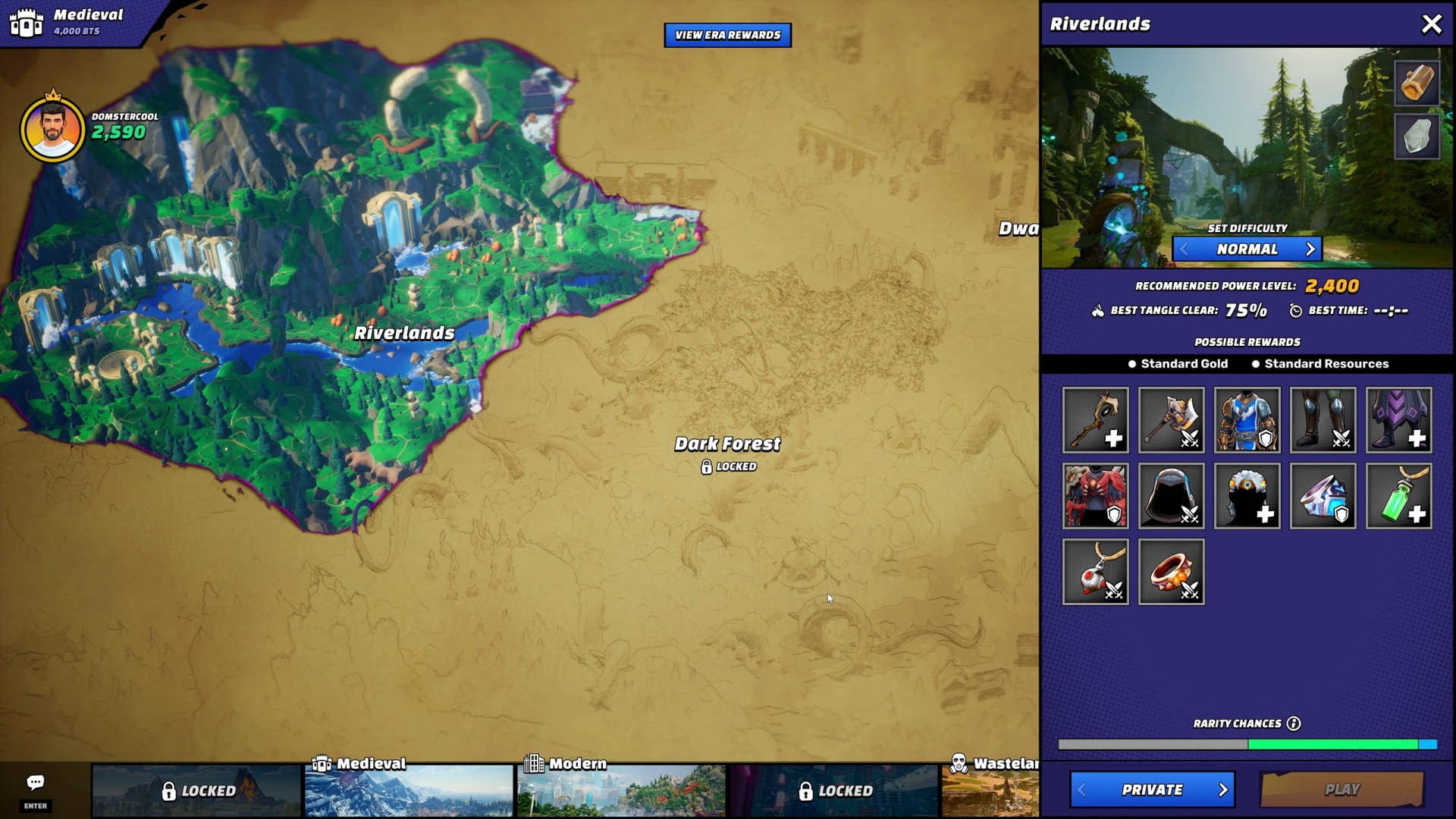
At the centre of Infinitopia is the world map, where players select their Era, level, and difficulty before choosing to create either a private or public game. There are also options for quick play. Public and quick play modes start a matchmaking search where other players can join who are also looking for games. I found that at lower difficulty levels it was harder to find a full party, often ending up playing solo or in two-player co-op while tackling the game’s three eras and twelve levels. As the difficulty increased, however, more players were actively looking for matches. Each level and difficulty has a recommended Power Level, so seeing other players’ Power Levels in Infinitopia gives you a good idea of where they are in the game’s progression. It also makes it easier to message them and ask if they’d like to run a few rounds together around your current Power Level range.
Once things get going, Out of Time will feel familiar to anyone who has played games in the Survivors-like genre. Most of these games use an isometric perspective, but Out of Time is fully 3D, offering a camera that can be zoomed in close for an almost third-person view or pulled back for a more isometric, dungeon-crawler style look. At the start of each mission, players begin in a safe zone, and once they hit the “Go” button in the centre of this protective sphere, they have 15 minutes to complete the mission before the Shattering arrives to end them. Mission objectives are always the same regardless of which level is selected: explore as much of the randomly generated map as possible to uncover enough of the area to summon the boss that must be defeated to complete the mission. This begins at 75% on normal but becomes higher on the higher difficulties. Hard is 85% while Shattered recently had a patch that made it 95%.
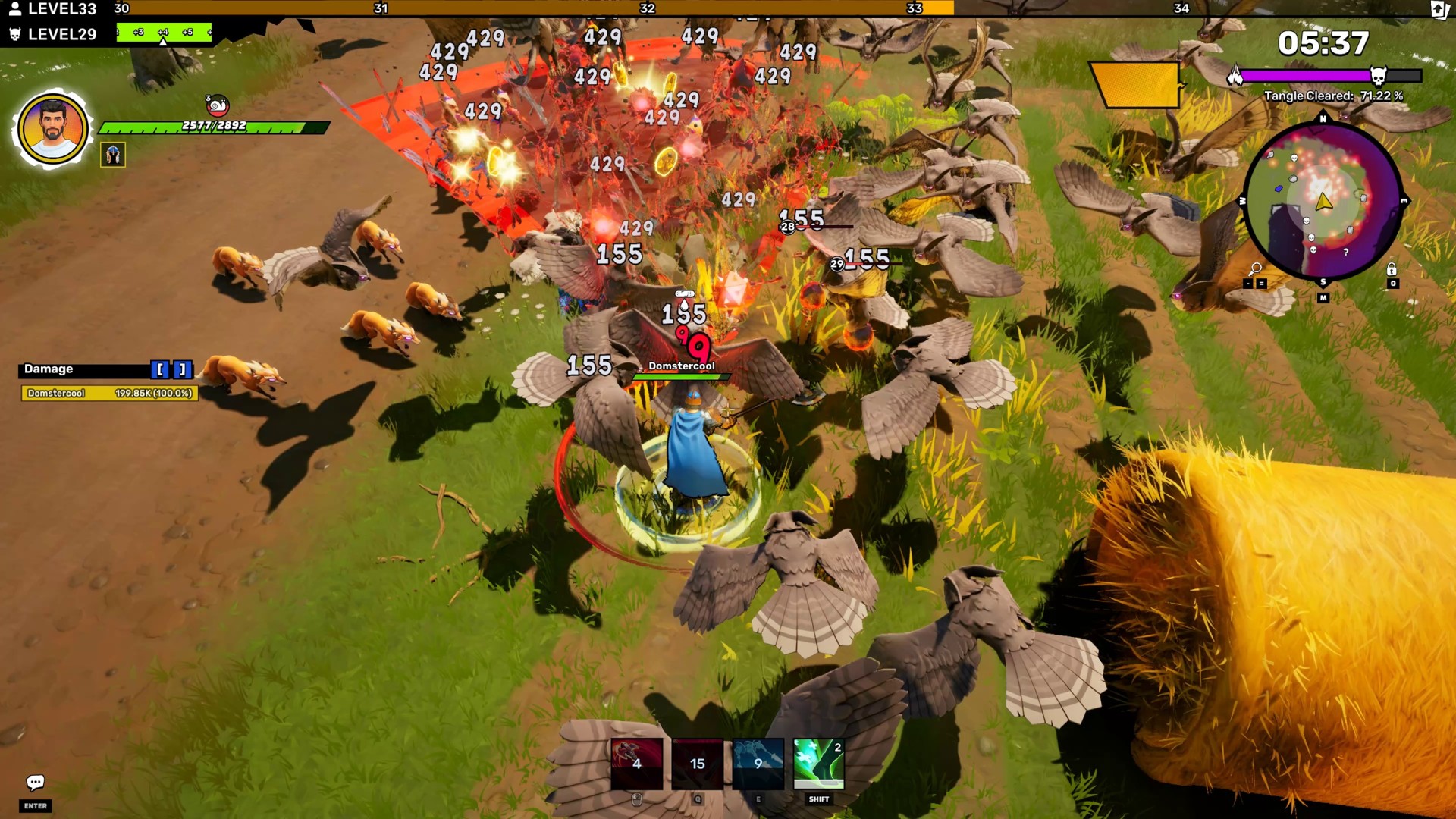
Each run starts the player at level one, and as enemies are defeated, experience is gained to increase the player’s level. Each level boosts base stats, while every five levels allow a skill upgrade to be chosen from four options. These skills are determined by the player’s equipped gear, as each skill is tied to a weapon, armour, boots, or helmet. The higher the gear rarity, the stronger the available skill buffs, following the usual common, uncommon, rare, and epic structure. This is where Out of Time feels refreshing for the genre as instead of using fixed characters or classes, abilities are linked directly to gear, with each equipment type offering its own distinct move set.
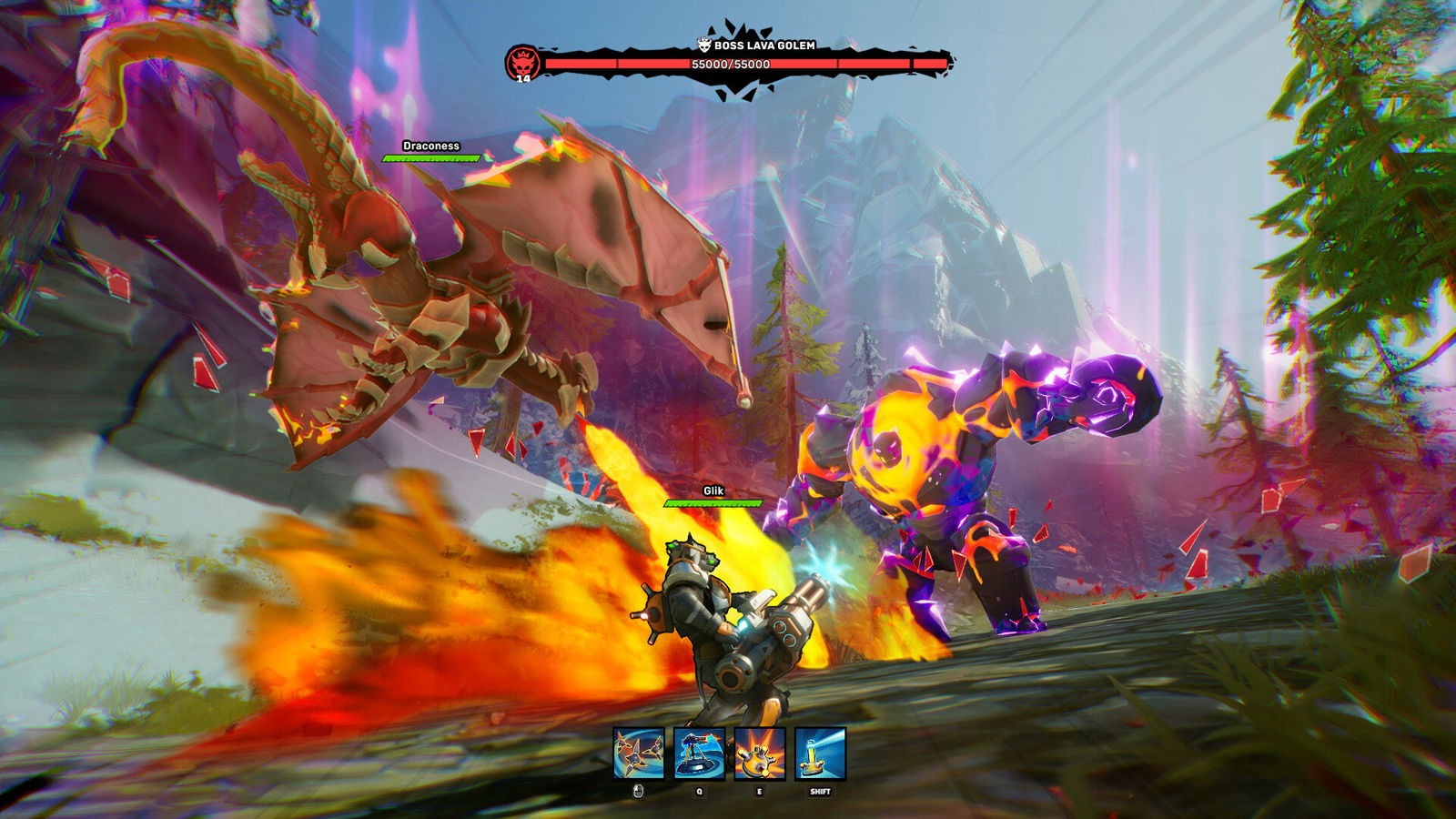
This system allows for some wild combinations, as skills come from each of the four gear parts mentioned. Weapons provide the auto attack and two active skills, armour offers one skill, boots provide another, and helmets give a passive ability. There is a nice variety available, such as melee weapons like axes, swords and flamethrowing electric guitars that offer close-range abilities, shotguns, rifles, rocket launchers, and dual pistols provide ranged attacks, with the pistols offering a fun spin-to-win whirlwind move, and miniguns deliver a high rate of fire but only work while standing still, making positioning critical. The minigun also comes with a skill to place mobile turrets to help during these stationary attacks. All skills have cooldowns, so they cannot be spammed.
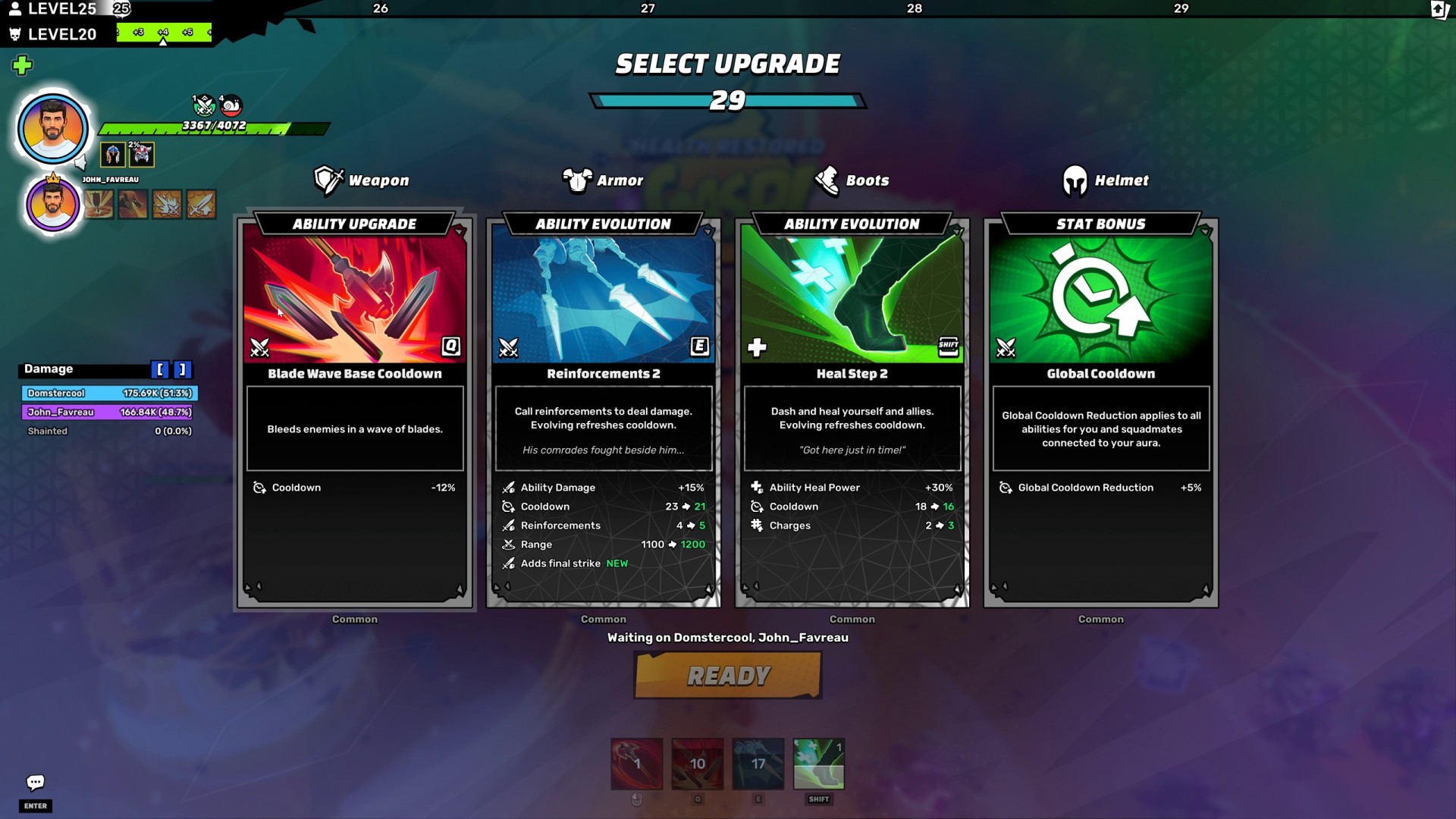
During my time with the game, I saw abilities such as transforming into a dragon to burn enemies to the ground, forcefields that slow enemies and heal players, boots that allow healing dashes, and other boots that drop flame fountains when running between them. I was summoning an ancient army with spears, firing medic guns with giant laser beams, had a personal healing bot, called in airstrike bombing, summoned pet wolves, and activated many others. Each skill matches the theme of the gear, such as mobster, barbarian, knight, special ops, and doctor to name a few. There are a lot of neat skills here that are taken from different eras, plus themes of fantasy and sci-fi, and being able to mix and match gear allows for some great builds that help players tackle the higher difficulties, though some combos do not always feel impactful as clearly some work better than others.
Bringing in one or more players adds another layer to the gameplay, the Tether. This is a blue energy line connecting players, and staying within its range provides rewards. The Tether system encourages cooperation by providing shared buffs, healing, and stat bonuses, but break the link and those buffs are gone, so rarely should players be splitting from each other. In single player, you miss out on this buff, which can make higher difficulties significantly harder to tackle alone. If a player dies in cooperative play, they can be revived, but this is limited based on how many players are in the match.
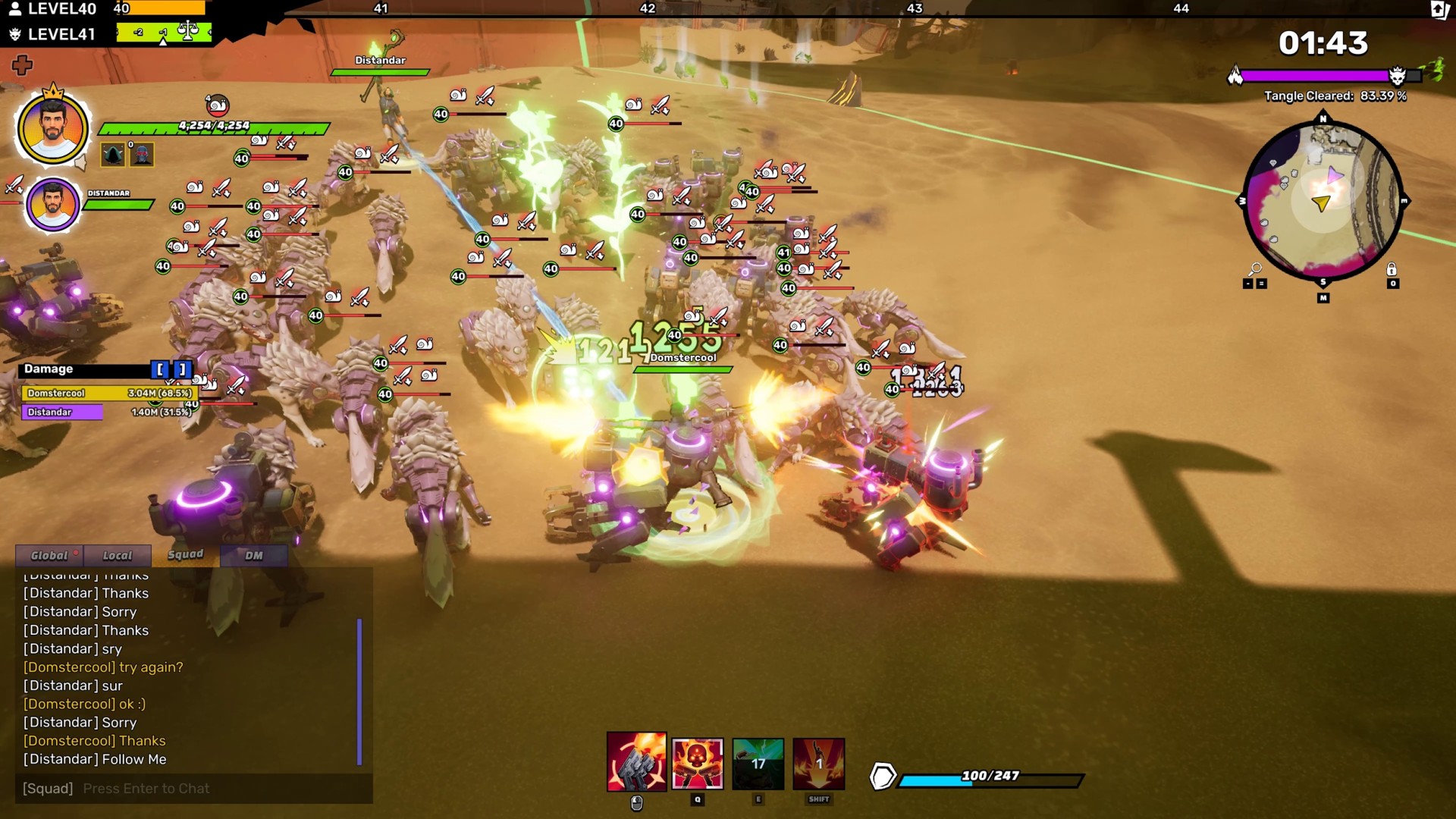
Whether playing solo or cooperatively, players face a decision between experience and time. As mentioned, there are 15 minutes to uncover a certain percentage of the map to trigger the boss. As the timer counts down, enemies grow stronger, with the game providing alerts under the player’s level details to show how much stronger or weaker foes are. Rushing to the boss may seem like a good idea, but it could leave you slightly under-levelled. On the other hand, lingering to farm experience might not leave enough time to explore and defeat the boss. Failing the mission in this way does not completely waste your effort, however, as any money and materials collected are kept, making each attempt still feel worthwhile, so while they will be many a times a run fails, the game does seem to respect the player’s time allowing them to use the cash and materials for the game’s roguelike element.
Two stores in Infinitopia use cash and materials: the Workshop and the Mastery Station. The Workshop is where gear can be levelled up to a maximum of 10. Gear that is uncommon or higher can be ascended to the next level bracket, up to what seems to be level 30, by using items obtained from salvaging unwanted gear into time bottles, which are required for ascension. Each piece of gear has stats and a general Power Level, but these stats vary depending on the gear’s theme. For example, a gas mask focuses on attack power, critical chance, critical damage, and critical multiplier, while a Healing Bot suit emphasizes healing power, healing regeneration, extra health, and experience gains. The game shows a small graph in the bottom-left corner of the inventory menu to illustrate how a build is distributed between attack, defence, and healing.
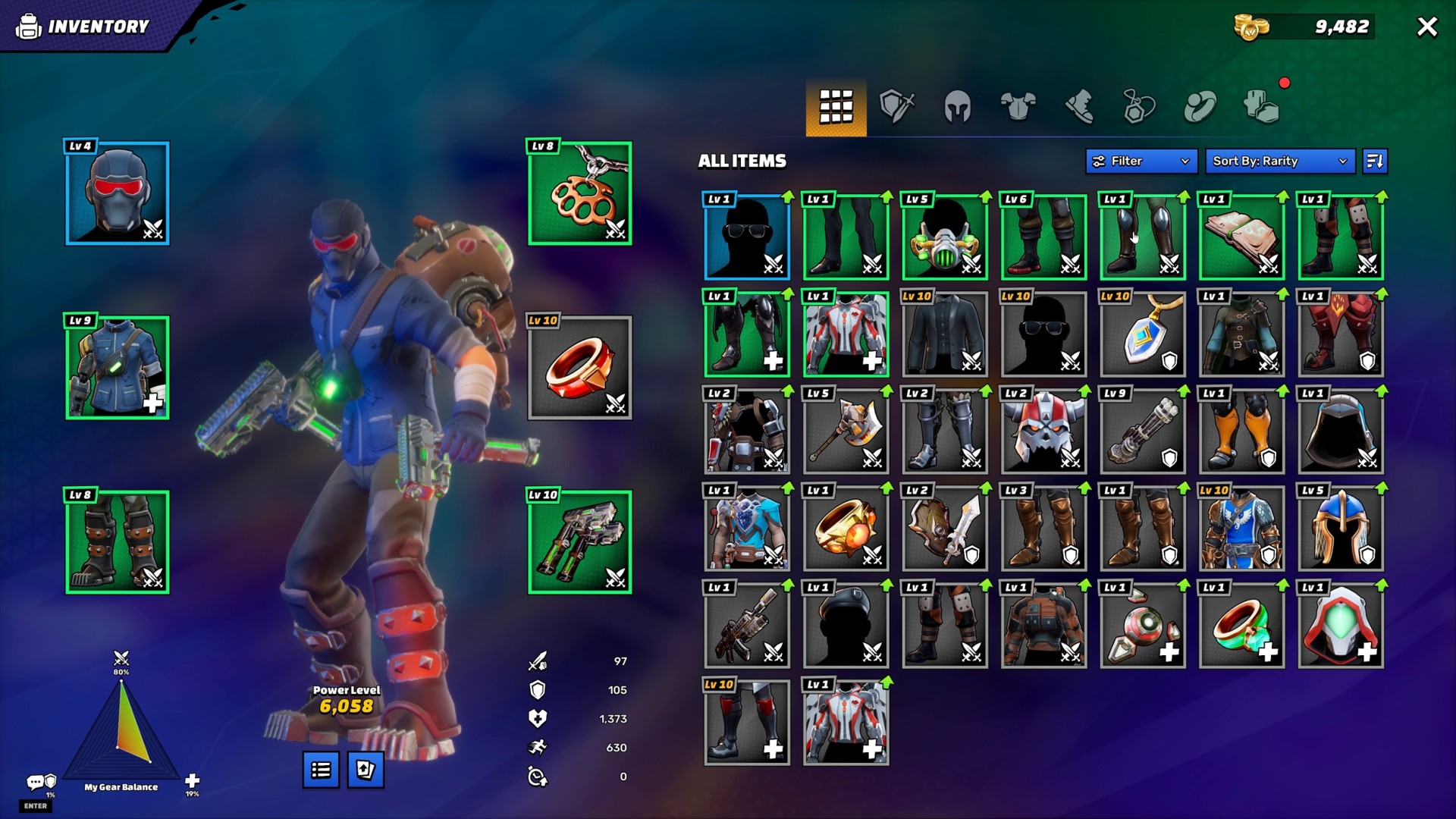
While switching gear means losing the investment made in previous gear, the Mastery Station is the place that offers permanent stat upgrades. In exchange for gold, players can permanently increase attributes such as armour, max health, attack power, and gold or material gathering based on element type, such as wood, stone, or metal. Each upgrade increases the cost of the next level, so reaching the maximum requires a substantial amount of gold. There is plenty to work towards as finding the best gear and maximising it for the higher difficulties will take a lot of time investment.
This ties into the genre and how long the game can keep players engaged before it becomes repetitive and falls into the familiar loot-and-stat grind. Out of Time is an auto-shooter, but the skills system as manual interaction and fully 3D maps add verticality through jumping and high ground, giving players some additional control. This makes the game a bit different than the normal genre superstars, but progression can still be grind-heavy and sometimes feels slow or unrewarding, as getting to the next difficulty rank can sometimes require replaying past completed levels to get gear to push you into the next Power Level tier.
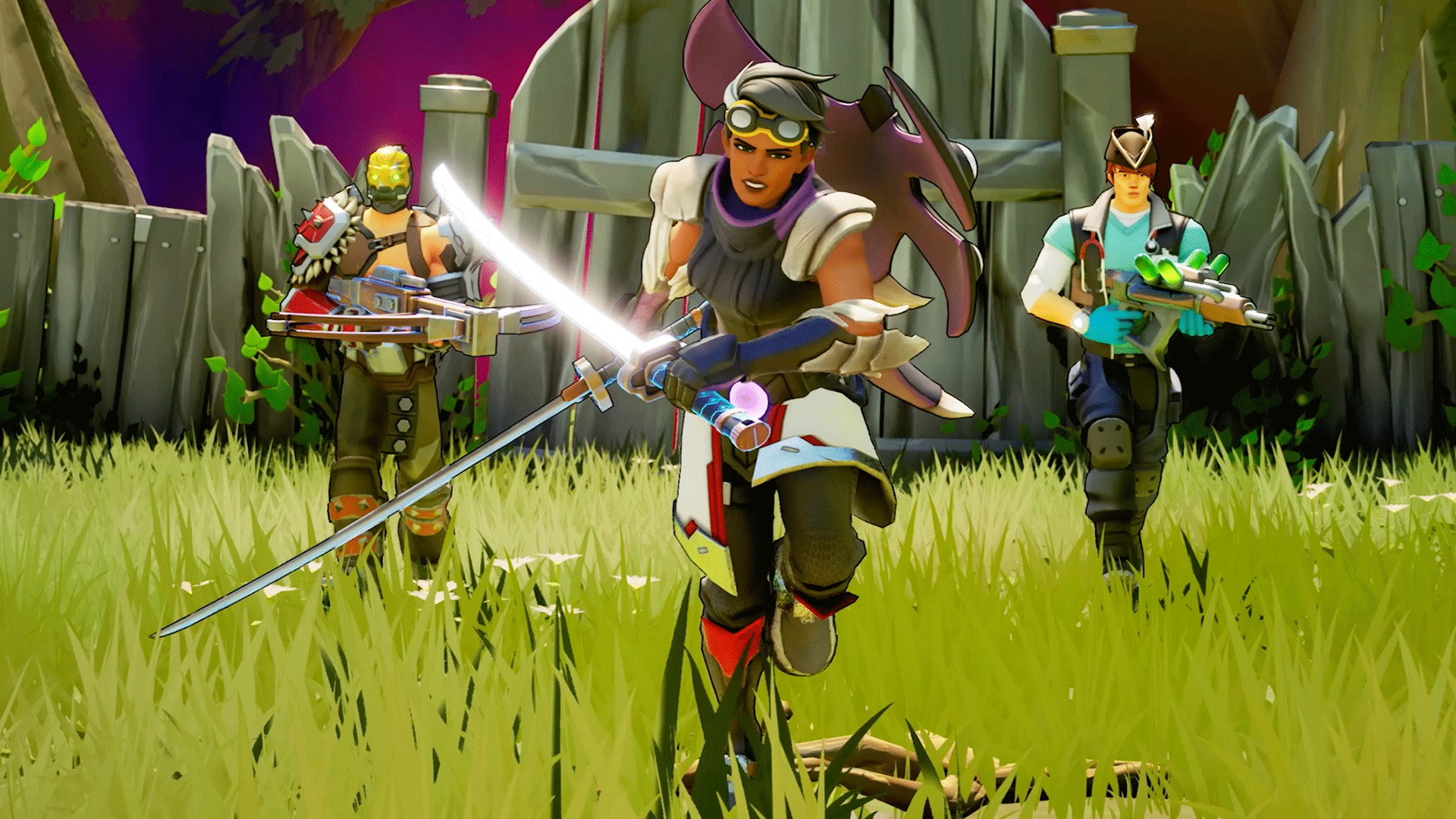
The maps are currently set within three main themes: Medieval, Modern, and Wasteland. Each has environments appropriate to its theme. Medieval includes the Riverlands, a green flourishing forest area, and a snowy mountainous village. Modern features farmlands and desert-industrial landscapes. Wasteland is post-apocalyptic, with broken roads and leaking power plants, think Mad Max, just not quite as stylish. Enemies match the themes: skeletons, tree monsters, and stone balls appear in Medieval; foxes, birds, raccoons, and wolves in Modern; and mechs, robots, and future soldiers in Wasteland. Some of these enemies have range attacks, some up close and some with suicidal tendencies to want to wipe the player out. While variety is there in themes, it can only sustain interest for so long as missions begin to feel repetitive, which may limit long-term engagement. Essentially, these themes are window dressing over similar map designs and enemy mechanics. Players who aren’t drawn to the simple but addictive loop of Survivors-like games may find it repetitive.
Inside the levels, there are optional purple Corruption points that players can interact with to start mini objectives. Completing these objectives grants a free skill upgrade, which is very helpful if you are falling behind due to enemy level scaling. The objectives are simple, such as standing on a point to charge a meter on screen, protecting a time capsule from enemies, or finding specific parts within a set time. Smaller Corruption points can be activated to gain a temporary power-up, including double damage, increased movement speed, a magnet that pulls in dropped gold and materials, or a screen-clearing bomb that wipes out nearby enemies. Then they are small hives which will release a mini-boss that on defeat drops a piece of gear to collect. Even though the core gameplay loop is combat-focused, these side objectives inject small mini-challenges so that players are not just running aimless to uncover the map.
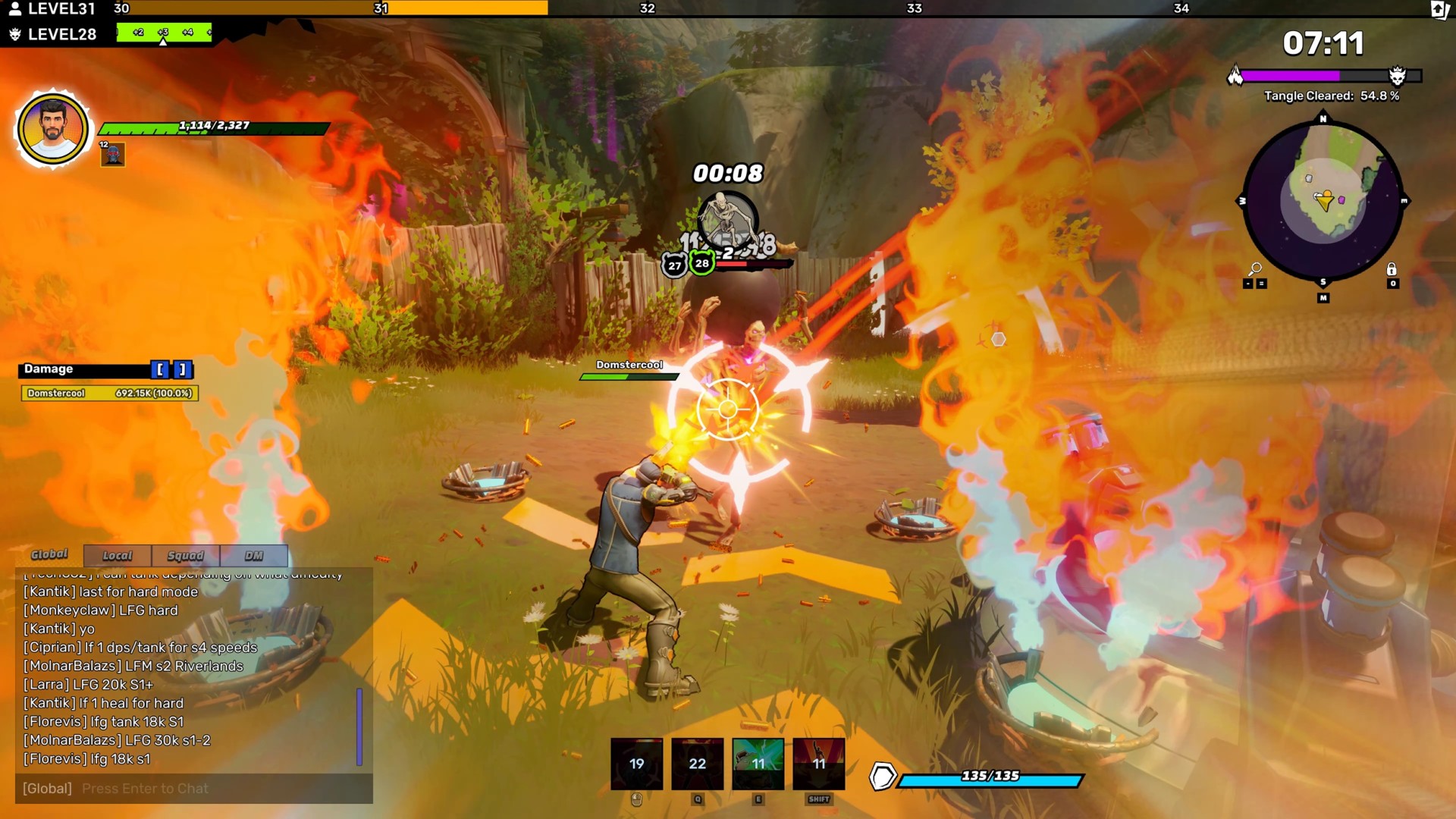
Each level has its own reward pool, so grinding isn’t completely random. The level screen shows which items can be earned by completing it. The randomness comes into play with which specific item drops and its rarity, as rarity affects the stats. The game does a good job of helping players avoid duplicates: the reward screen shows if you already own a piece of gear, and a recent patch ensures that duplicate drops of the same item type and rarity no longer occur. This makes it possible to work toward the gear needed for your build.
Out of Time makes killing hundreds of enemies feel satisfying thanks to the variety of powers unlocked through gear. For someone like me, who has played several games in this genre and invested time into them, it kept me interested to keep playing and improving my character for the game’s incredibly challenging difficulties. Will I ever get that far? Probably not, as I will eventually get bored, but future updates have the potential to pull players back in. Manticore have already said future updates are coming, mostly free, such as the three new Eras planned that are currently locked on the map selection screen (Solar Punk, Prehistoric, Cyberpunk), plus new gear, avatars, seasonal events and even game modes. The developers have already the experience in building updates thanks to their Core platform, so hopefully Out of Time can get the support it needs in timely fashion to keep the content fresh before the grind dries out the enthusiasm.
Currently, the game is only available on the Epic Games Store for PC at £19.79, which makes it one of the more expensive Survivor-like games, as this genre is usually known for its budget-friendly prices. It appears to be a time-exclusive too, as the game already has a Steam page with minimal information and no release date. I would expect it to appear on Steam in roughly six months if the Epic Games Store is not your preferred platform to purchase games. There is also a console version planned for 2026 for those without a PC.
Despite using Unreal Engine, the game’s system requirements are modest: a Nvidia GeForce GTX 1050 Ti and an Intel Core i5-7400 are enough to run it. The visuals are stylistically like the cartoon cel-shaded approach of Fortnite, with some human models looking like they could be straight from that game. While the graphics look sharp in 4K during gameplay, the detail is basic and map design is simple, which helps keep the graphical demands low while looking a bit rough around the edges. It visually looks more like a budget title and that is fine as it is mostly priced accordingly.
I also noticed that some menu elements do not scale properly. For example, my character model in the gear menu appeared aliased, as if it were rendering at 1080p while the rest of the game ran at 4K. I checked other videos on YouTube and saw the same issue, so it seems to be related to how the game handles rendering. Frame rates are fully uncapped, allowing for smooth gameplay, which is important when the screen gets chaotic with enemies exploding all at once. One downside is the lack of ragdoll physics, as enemies all die in the same repeated animation. Ragdolls would have fit perfectly with the game’s silly themes, where dragons, foxes, and killer cyborgs coexist being killed by the Yakuza, Knights, Soldiers, Mages and Cyber Medics. Including ragdoll physics could have added more humour with far-fetched death animations to the chaos.
In summary, Out of Time warps into the Survivors-like genre with a mix of chaotic, era-mashing, auto-action, and a gear-based skill system that sparks creative builds. The Tether mechanic encourages co-op play, which is the better way to play the game. Future updates, including new Eras, gear, and modes, should help give the game legs for the long haul. Yet, repetitive missions, and simplistic and mundane map design, and minor hiccups keep it from standing at the top of the genre. For genre fans with time to spare, Out of Time is a fun ride, but it will not stop the clock as a true standout in the genre.